? You'd think that wineries in California would have their bottles stored in such a way that they could withstand at least a 6.0 earthquake ?
Probably just cheaper to buy the insurance and cross your fingers.
Oh, it's going to be worse than you can imagine, if New Madrid does what it did in 1811 again. I didn't realize it until I just looked it up, but the 1811 - 1812 event was actually 4 magnitude 7 - 8 earthquakes in less than 2 months. Because of the geologic history of the Mississippi River, everything from St. Louis to Memphis is nothing but sedimentary embayment. The sonic waves travel through it almost as well as it does through ocean water.
From Wikipedia:
http://en.wikipedia.org/wiki/1811?12_New_Madrid_earthquakesThe four earthquakesDecember 16, 1811, 0815 UTC (2:15 a.m.); (M ~7.2 ? 8.1) epicenter in northeast Arkansas. It caused only slight damage to man-made structures, mainly because of the sparse population in the epicentral area. The future location of Memphis, Tennessee, experienced level IX shaking on the Mercalli intensity scale. A seismic seiche propagated upriver, and Little Prairie (a village that was on the site of the former Fort San Fernando, near the site of present-day Caruthersville, Missouri) was heavily damaged by soil liquefaction.
December 16, 1811, 1315 UTC (7:15 a.m.); (M ~7.2?8.1) epicenter in northeast Arkansas. This shock followed the first earthquake by six hours and was similar in intensity.
January 23, 1812, 1515 UTC (9:15 a.m.); (M ~7.0?7.8 ) epicenter in the Missouri Bootheel. The meizoseismal area was characterized by general ground warping, ejections, fissuring, severe landslides, and caving of stream banks. Johnson and Schweig attributed this earthquake to a rupture on the New Madrid North Fault. This may have placed strain on the Reelfoot Fault.
February 7, 1812, 0945 UTC (3:45 a.m.); (M ~7.4?8.0) epicenter near New Madrid, Missouri. New Madrid was destroyed. At St. Louis, Missouri, many houses were severely damaged, and their chimneys were toppled. This shock was definitively attributed to the Reelfoot Fault by Johnston and Schweig. Uplift along a segment of this reverse fault created temporary waterfalls on the Mississippi at Kentucky Bend, created waves that propagated upstream, and caused the formation of Reelfoot Lake by obstructing streams in what is now Lake County, Tennessee.
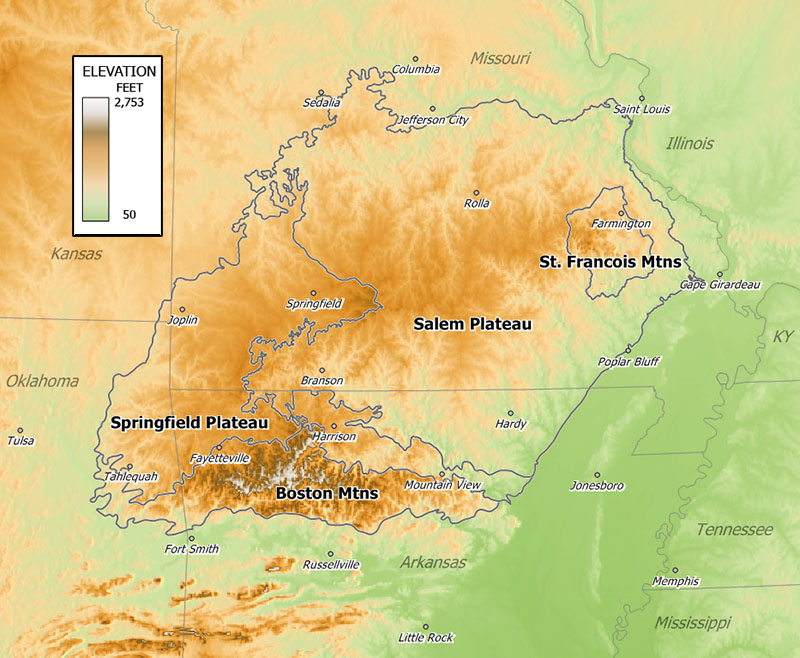
My location is not so precarious. I'm over toward the center of the Arkansas/Missouri E/W line, just west of Hardy in the foothills of the Ozarks. The land under me, and for miles in the direction of New Madrid, is very ancient eroded plain of the Salem Plateau. It is Ordovician dolostones, sandstones and limestones. We might feel it here, but it probably wont do much, if any, damage. The Ordovician period ended about 443.7 million years ago.
Still, the more immediate concern is the San Andreas fault and its surrounding faults, which have the propensity to rock the ground almost as hard and much more often. Glad to hear your area was spared!


